Full Text: In Search of the Imperial Parrot, Part I

You’ve asked, so I’ve transcribed the complete text of Sydney Porter’s “In Search of the Imperial Parrot (I)”, as it first appeared in Avicultural Magazine in October, 1929. Eighty-eight years ago! I hope you enjoy reading (and rereading!) the story as much as I have. Thanks again to Josef Harold Lindholm III, Curator of Birds at Tulsa Zoo, for copying and sending the original Porter articles via snail mail. I’ll share Part II in an upcoming post.

slwa_b3293538_1

In Search of the Imperial Parrot (I)

by Sydney Porter

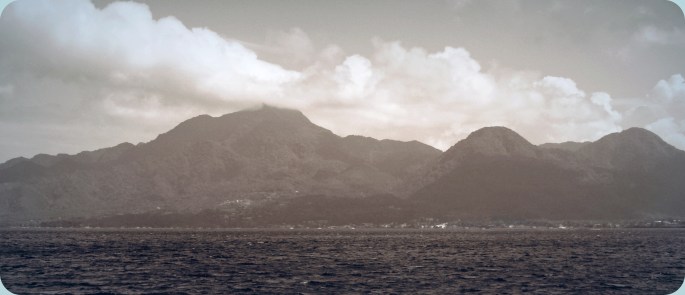
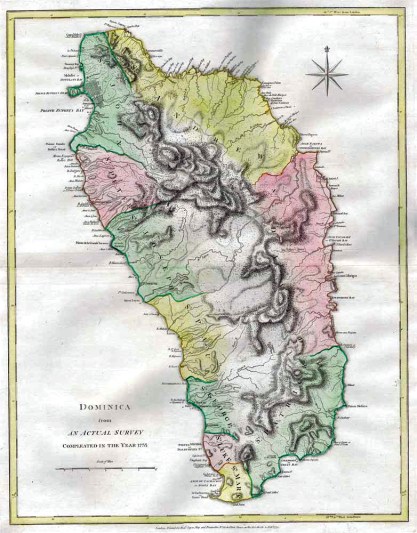
A matter of between four and five thousand miles away and a three week’s journey from the shores of England lies the world’s most incredible island. It is one of those places of which, when one enthusiastically describes it to a friend, one is conscious that, though they listen tolerantly, they take all one says with the proverbial grain of salt. Seen from the first time from the sea, one is struck by its sinister and awe-inspiring grandeur. Imagine an island about the same size and shape as the Isle of Man, with all the highest mountains of the British Isles crushed up and put upon it– though several of the peaks there are higher than those of our islands–rising sheer out of the sea, their feet resting in the water and their summits hidden by the clouds, the only place I know of where palm-trees thrive above the mists, striving to add a still greater height to the already great towering volcanic peaks. If you can imagine this and a hundred other things, then you have Dominica, the fairest and yet the least-known of the Leeward Islands in the Caribbean Sea. Its visitors are few, but its hospitality is second to none in the world– perhaps the former is the reason for the latter!
OLYMPUS DIGITAL CAMERA

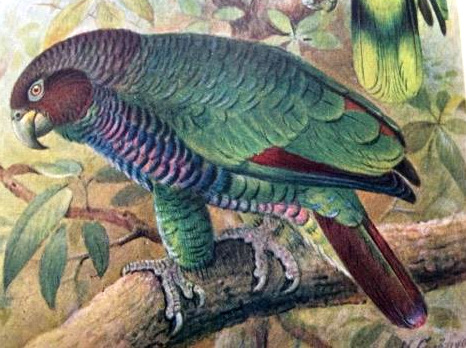
It is perhaps appropriate that this wonderful island should be the home of one of the world’s rarest birds, the Imperial Parrot (Amazona imperialis), which for some years has thought to be nearly extinct; and the chief reason for my visiting the island was to ascertain whether this singular bird is still alive. Fortunately for ornithologists, it is, but unless special care is take its days are numbered.
map

For many years, I had cherished in my mind a desire, or I might say a vague hope, that one day I might be able to find something definite concerning the fate of either one or more of the rare and supposedly nearly extinct Parrots which inhabit the more remote Wet Indian Islands. I did not think that such a desire would materialize, and it was only by a series of extraordinary coincidences that it eventually did, and with what luck I will relate later on.

nam1-b020

When I set sail at the beginning of February, after several months of indifferent health, in search of the sunshine in Jamaica, I had not the slightest intention of ever setting foot in the lovely island of Dominica, but it was in this latter country that I did eventually arrive, and not in the former. I will explain. Our boat, which was bound for Barbados– the jumping off ground for passengers bound for the lesser-known West Indian Island–carried as passengers several residents of the Lesser Antilles, who were returning after a trip to Europe, and as I got to known them I questioned them about the rare Parrots from the respective islands. But few of them knew anything about the birds except the Parrot from St. Vincent, which they regarded more or less as a myth; but two days before landing at Barbados I was introduced to a charming lady who resided on Dominica, and who knew Amazona imperialis well. She said that it had always been very scarce, but now it was excessively rare. It used to be shot and eaten by the natives in fair quantities, and that even now it was occasionally shot and eaten by them (a fact which later on proved to be only too true), and sometimes when a bird was slightly wounded in the wing or leg it was taken by the natives and sold. Such a specimen was brought to this lady’s sister the year before last by a native, from whom she purchased it. I understand that it was wounded in the wing; in fact, the part from the elbow had been shot away. It was kept in a large cage, made out of a packing case, but appeared sullen and morose. It was sold by her later at a good price to an American institution, of which she could not remember the name. I asked this lady whether it were possible to secure examples, but she said that there was no royal road to get to them, and it was only by the rarest luck that the natives got hold of them, for there was no way of snaring them or procuring the young as the birds nest in the highest forest trees which are quite inaccessible, though upon one occasion she heard of a tree being felled which contained a nest of fully-fledged youngsters. So upon this information I decided to alter all my arrangements, and come to the island and try my luck at either securing a specimen, or at least seeing these magnificent birds in a state of freedom. Fortunately I was able to do both.

porters desk

Upon landing I was introduced to the lady’s brother, who with true colonial hospitality at once offered to lend me his old home which was situated in the remote part of the island where these birds still exist; in fact, it was the only house in the vicinity, and nearby lived the only hunter who knew and was familiar with the birds in their breeding haunts. Anyone else landing in the island in quest of the bird would have a very remote chance of meeting with the bird unless he had the same good luck that I had. Often people in the island will tell you that bird still exists, but they don’t know where. They will say when questioned: “Oh, away in the forests!” but as the island is covered with this forest this does not imply very much. In fact, there are very few people in the island who have ever seen even a captured one, and I think that within recent years practically no white man has seen one wild except myself. The old hunter took me and after three hours of the roughest climbing I have ever done or hope to do again, brought me to the tree where the birds are.

roseau vintage1

As soon as I arrived at my destination after having spent several days in Roseau, the tiny but charming capital of the island, I naturally made inquiries regarding the whereabouts of the Parrots. The natives all knew of the birds, but I was told that I had come at the wrong time of the year, for the birds were already far away breeding in the deepest recesses of the mountain forest, in parts which were inaccessible to human beings. This sounded far from hopeful , but at night the old native hunter already mentioned turned up and told me that he was the only man in the district who really knew all about the “Ciceroo”, which is the native name for the bird. He informed me that if I liked to go for a two or three days’ journey through the forests with him he would show me dozens of the birds, but if I only wanted to see one or two it would be only necessary to make a day’s journey. Now finding that the natives of Dominica are singularly honest and truthful, differing very much in that respect from their cousins in Africa, I had no reason to doubt his word, which in every way proved correct. I decided on the latter alternative, so on the second morning after, we set out. I have undertaken some rough trekking in my time, but this beat everything I have ever done. No wonder Amazona imperialis was thought to be extinct or at least nearly so. The way lay for the most part up and down almost perpendicular cliffs of about 1,000 feet high, and these were covered with the densest tropical vegetation. I think that we used our hands more than our feet: many times I nearly gave up, but just as my lungs seemed bursting and my strength almost gone, we would reach the top and the descent would give me strength for the next climb. Sometimes we had to follow the course of a rushing mountain river, struggling to get from one boulder to another. On and on we pushed, sometimes there was a few minutes’ rest when the guide was hacking out a pathway with his cutlass from the dense undergrowth. My face and hands were cut and bleeding from contact with the sharp razor-grass, and the going was made more difficult by the fact that the heavy red soil stuck to one’s boots and made walking exceptionally trying.
Fullscreen capture 10292017 104229 PM

The great forests were singularly destitute of animal life; large yellow and brown land crabs which hurried up the trees as we passed, and occasional specimens of Bouquet’s Parrot* (Amazona bouqueti) were the only signs of life. At last my guide informed me that we were in the district. Sure enough in a few minutes we heard the loud ringing cries of A. imperialis, and two birds flew out of a huge forest tree, circling around with almost motionless wings, looking very much like small eagles and very dark in color when silhouetted against the sky. A little later on we came across another pair feeding upon a great fruit-bearing forest tree. I cannot describe the thrill as I lay upon my back on the hot steamy mould, gazing up at the birds through my binoculars; I realized that a long-desired wish had at last materialized, and I wondered how few white people had ever seen or perhaps ever would see these magnificent birds, undisturbed in the solitude of their wonderful forest home. Only a keen naturalist will understand my feelings when, after traveling thousands of miles, I beheld these creatures which had long held to be extinct. I felt somehow like Wallace did when he first saw and handled the King Bird of Paradise (Cicinnurus regius) as so well described in his wonderful book The Malay Archipelago. All my fatigue vanished. I did not not feel the cuts and bruises.

The cock of the pair fed on the fruit, continually letting fall half-eaten ones which somewhat resembled a very dark purplish pomegranate. This fruit has a vile taste when eaten in the unripe state in which the birds appear to like it; even if only touched by the tongue it leaves a horribly bitter and astringent taste in the mouth for a long time afterwards. When quite ripe the outer peel splits into five sections and opens out like a star, thus exposing the interior which looks like a small grapefruit with the peel and skin removed; also when quite ripe it loses some of its terribly astringent taste. Though I tried the bird which I later secured with it, and also the Bouquet’s parrots, they all refused to touch it. This was exceedingly strange as it forms the main food of both birds in the wild state.

The hen of the pair I was watching (the guide said that it was the hen, though I could see no difference between the two) ran slowly up and down a bare branch of creeper which hung between the two trees, so that I got a splendid view of her. She struck me as being very dark purple; the head looked small and Vulture-like, and half the tail seemed to have been broken away. This may have been due to the fact that she was nesting.

Sisserou2

My guide told me that two months previously he had a pair of these birds, which he had shot. One, which was badly wounded, died in a few days, but the other one, being merely stunned, recovered and he kept it for several weeks, but there being no prospective buyer in the district (I believe I was the only visitor who had stayed for any length of time in that part for some years) and the bird being very fat, my friend cut its throat and had it for the evening meal. I nearly said I wished it had choked him, but if it had done so I would never have seen A. imperialis in its wild state! Some weeks after this trip I was speaking to a native hunter– and he said, “Law or no law, we shall always shoot the ‘Ciceroo’ when we can. We pay a license for a gun and if we go hunting and find no wild pig or agouti and we see a ‘Ciceroo’ we just shoot it because we have no meat.” I mentioned about keeping fowls as a constant supply of meat, but the answer was, “Fowls cost money to buy and we can always sell them, but we can’t sell a ‘Ciceroo’.”

INACCESSIBLE

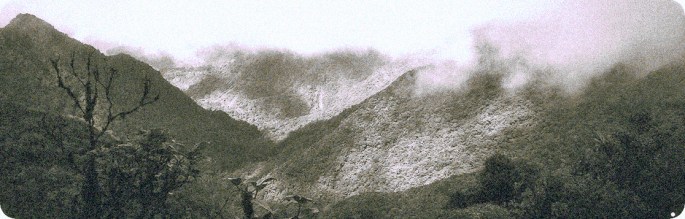
I falter before the task of describing to the reader something of the utter grandeur of the deep, almost inaccessible forest-covered gorges and ravines which form the home of the Imperial Parrot. It requires an artist in words to paint a pen picture that will in the slightest degree convey anything of the magnificence of the mountain ranges of Dominica. I have seen a good many groups of wild and rugged mountain ranges in Europe and elsewhere, but none have ever appeared so impressive as those which form the home of the “Ciceroo”. Nowhere do mountains rise so sheer or are the ravines so deep and precipitous. Sometimes the walls of the gorges rise perpendicularly for thousands of feet, covered by the densest tropical creepers and ferns of the most vivid emerald green. From the distance the island looks like a jagged emerald rising up out of the turquoise sea. The rainfall in some parts is as much as three hundred inches a year and this, combined with an average temperature of about 85 degrees F, gives a wealth of tropical vegetation which can well be imagined. Giant palms and tree-ferns mix with other vegetation in the struggle upwards towards the light. Here and there great forest giants lie prone, their great bulk almost hidden in the rank growth of mosses, etc.  It is here, in some places impossible for man to penetrate, on the Atlantic slopes of the sinister volcanic peak, Morne Diablotin (Mountain of the Devil) that A. imperialis makes its home. Long may it hold its own.

Of course the Imperial Parrot is rightly protected by law, but as a gentleman in the Administration said to me, it is absolutely impossible to enforce the law in such a district. The only laws known in those parts are the laws of Nature. But the bird is protected by Nature in such a way as no other creature in the world is, for I know of no living bird whose numbers are as small as those of A. imperialis and yet has managed to maintain itself as this bird has. Its home is the most remote, the most inaccessible, and the approach the most dangerous that I know of. All this may sound rather ludicrous when the island is only about 15 miles by 30, but the position must be seen to be appreciated.
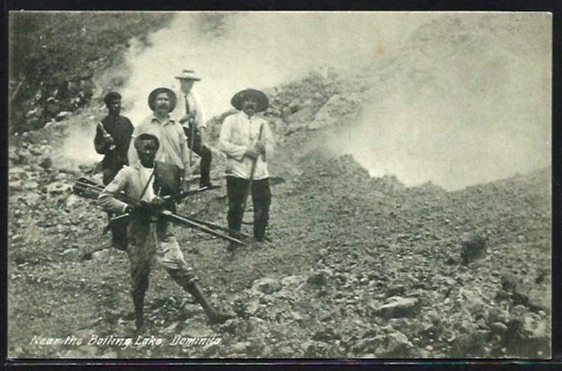
bwi1

I believe that this species will not be exterminated for some years to come, that is if great care is taken and no one is allowed to collect an unlimited number of specimens, especially for museums in the United States. I am not speaking disparagingly of American institutions, but there is a tendency to stock the museums in the States with rare specimens, which is only natural, as most of the museums in Europe which have been established for a much longer time are already full. The species in the flesh is far more valuable to the coming generations than dried skins in cabinets, even though the birds live in inaccessible forests.

I regret to say that when they stray away from their natural home the birds are still shot by the native gunners now and then for food. This is a great shame, for I hear that the flesh of these birds is very tough and leathery. I was asked to sample the flesh of one of these birds, but even had I not been a vegetarian, I should have refused. It is a great pity  that they are eaten, for there is an abundance of food on the island, but the natives have no idea of the rarity of the species.

(To be concluded)

*Dominica’s Red-necked amazon (Amazona arausiaca) was once known as the Bouquet’s Parrot

Dominica-GVI-1-2d-Block-of-4-MNH-97

Sisserou Post-Hurricane Behavior: A Note from Sydney Porter

Carl Plath 1931

As the search for the Sisserou continues today on Dominica, I thought I’d share a few pertinent passages from Sydney Porter’s article “In Search of the Imperial Parrot (II)” from Avicultural Magazine, November 1929:

I paid a visit to a small shack belonging to the lady who so kindly sponsored me during my stay on the island. It was situated in the high mountains 8 or 9 miles from Roseau on the leeward side of the island. While there I met a cultured young man…and during our conversation I mentioned the “Ciceroo” and asked him whether he knew anything about it. To my surprise he gave me a rather interesting piece of information. He stated that just after the terrible hurricane of the autumn of 1928 when great damage was done on Dominica, a flock of these birds numbering from one to two hundred, which he thought was the entire population of this species, appeared in the valley where he lived, apparently seeking food, owing to all their own being destroyed. The flock stayed for a short time and then broke up into small parties and dispersed in different directions, but not before ten had been shot and eaten.

I was able to get information upon which I could account for over thirty-eight birds being killed and captured during the last three months of 1928 and during the first two months of 1929. This includes twenty birds killed by two men, including the ten mentioned above. Of course, it must be accounted a very exceptional year, for the birds were driven out of their haunts by a hurricane, but thirty-eight birds out of a total of less than two hundred is a very heavy toll, and if the killing were to go on at this rate the birds were to stand very little chance, as they are slow breeders. The natives say that they lay only one egg, but they really don’t know much at this point. I am sure that the birds have no natural enemies except man. Only two escaped with their lives, my own bird and another which is also in England but I cannot trace where. Several birds would have escaped the death penalty had there been prospective buyers on the spot.

A horrified Porter witnessed the shooting of an Imperial while exploring the steep mountain haunts of the rare bird, observing:

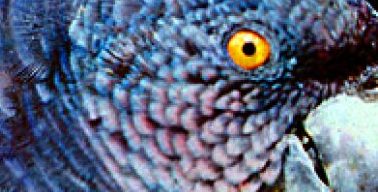
…what gave me a great thrill was the sound from numerous throats which I knew belonged to A. imperialis, and gazing up I saw these wonderful birds flying round with the equally rare A. bouqueti feeding upon the fruits of the huge forest trees or climbing about the creepers which festooned the tops. I watched through my glasses one old hen who climbed about with the agility of a monkey. I liked the look of her because she looked such a sophisticated bird, but all at once I heard the report of a gun and saw her fall fluttering to the ground. My men had brought guns to shoot wild pig and agouti, and they had gone off apparently in search of such game, at least I thought so, but in a few minutes they came back looking highly pleased with themselves. ” We got you a Ciceroo, sar, her no die, only wounded in de wing,” was what they greeted me with. I hoped this might be so, and for a short time gazed entranced upon this glorious creature which I had traveled so far to see, and I ardently prayed that she might live, but alas! in a short space of time I could see by her eyes that she was mortally wounded. I picked her up and with a lump in my throat saw the lovely shining purple head sink back and the beautiful orange eyes close in death and heard the last few short gasps as she breathed her last. I cannot tell how I felt, it seemed as though I had broken some sacred trust. I had wandered into these Elysian fields and behaved like a vandal, for I felt that the crime was upon my own head, and I would have given anything to have seen her back in the tree tops. My shame was increased when, later on, I saw the poor thing plucked and dressed for the pot.

The flight feathers of this bird were worn and frayed. In fact, I have never handled a wild bird whose feathers were in such poor condition. Not a single wing or tail feather was perfect. Every one was broken or frayed. Evidently, it was one of the birds which had been driven out by the hurricane and had returned to find a worse fate. When this bird was shot, a pair of Bouquet’s Parrots [now known as Red-necked parrots (Amazona   arausiaca)] flew down and screamed their rage at the hunters.

Since Maria hit Dominica as a Category 5 hurricane on September 18, no Sisserous have been sighted in the devastated forests of the once-verdant Nature Island of the Caribbean. Like the Imperials in Porter’s article, Red-necked amazons have been spotted ” apparently seeking food, owing to all their own being destroyed.” Exhausted, starving, and disoriented, the lovely Jackos, as the Red-necks are known on the island, have been spotted flying down to fallen citrus and to food put out for them by those able to help the birds to survive their most desperate hour.

Unfortunately, no Sisserous have been spotted as yet making a similar bid for survival.

I will keep reporting as I receive more information. Hopefully, the regal Imperial, largest of all amazon parrots, will be given one more chance at a future.

The Parrots of Eden, Part I: Fire and Ice

IMG_6261
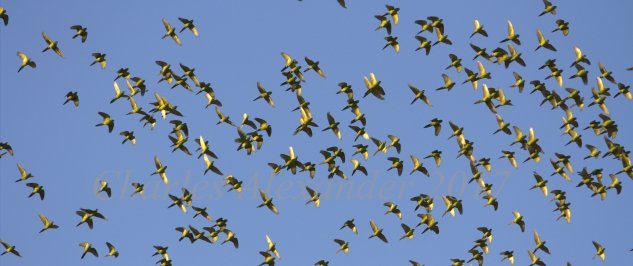
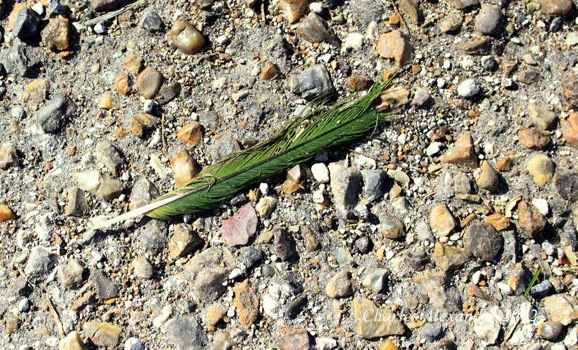
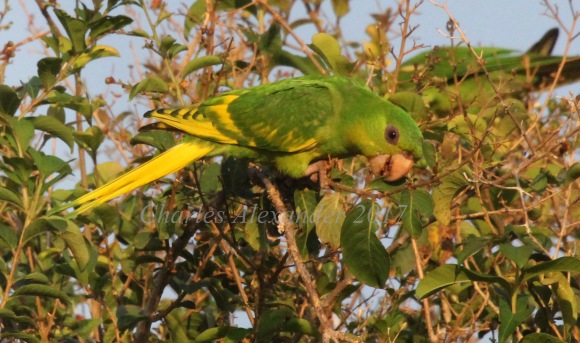
Green parakeets (Psittacara holochlora) take wing. Photo: Charles Alexander

A flock of wild green parakeets just flew over my house, circling and screaming. I can hear them as I sit at my desk, in the home that I’ve made for myself here in the Rio Grande Valley of Deep South Texas.

txmx

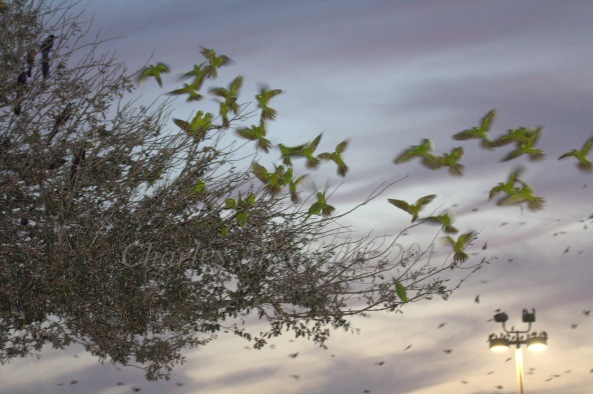
The parakeets arrive in the early afternoon, often as many as a hundred at a time, to feed in the hackberry trees just outside my studio door. At this moment, their voices sound especially frenetic. Possibly, they’ve spotted a Harris’s hawk and have burst into flight to announce the raptor’s unwelcome presence. The penetrating voices of the parakeets, chanting in unison and clearly audible through the walls of my old adobe home, are a daily phenomenon here, just two miles from the Mexican border.

The Valley is home to thousands of wild parrots. I know because I have counted them often. Since first visiting this most southerly outpost of the Lone Star State eight years ago, I have been drawn ever deeper into the lives of the amazons and parakeets of the Texas frontera. My name is Charles Alexander. I am a wildlife painter, writer, and naturalist. Though born in East Texas and raised in West Tennessee, I feel right at home now in this land of green jays, great kiskadees, and parrots—a place where the birds of tropical Mexico meet and mingle with the birds of the United States.

IMG_1637-001

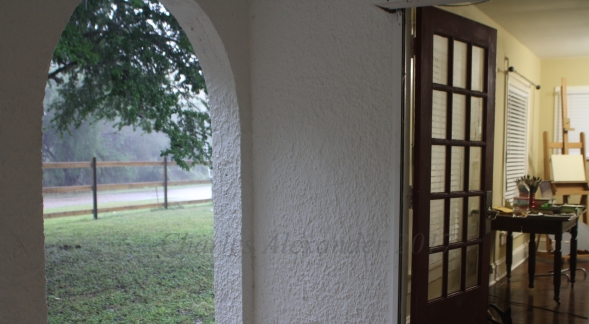
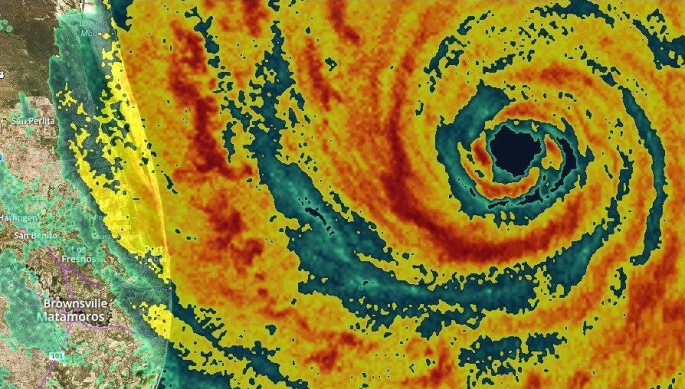
Recently, Hurricane Harvey threatened our world here. On the afternoon of the 24th of August 2017, the door to my studio suddenly flew open as I was rushing to pack away valuables. An unwelcome visitor was calling. The newscasts were unequivocal: Harvey was coming. That afternoon, the storm had undergone rapid intensification in the Bay of Campeche, morphing from a tropical storm into a Category Three hurricane, tracking north by northwest.  The wind was picking up.

tropical storm harvey

A relative newcomer to the Valley, I had never experienced a hurricane, much less a tempest of Harvey’s magnitude. My girlfriend Natalie Lindholm—Supervisor of Birds at the Gladys Porter Zoo here in Brownsville—was safely away at a wedding in Washington, D.C. Alone with four cats at the end of our rural road, I began to prepare for the worst: battening down the storm shutters, storing away family mementos, packing away anything fragile or electronic, making that last-minute grocery run —all the while fearing that my studio, archives of photos, paintings, years of wildlife research, all could be wiped out overnight. More urgently, I feared for the lives of our Valley birds, especially the wild parrots. I already knew what could happen in a storm.

IMG_2281

The dread of what was approaching took me back five and a half years, to March 29, 2012. On that day, a Thursday, I was nearing the end of my first three weeks of green parakeet field work, a study that I was conducting independently, on my own dime and initiative. Those inaugural days with the Valley’s wild parrots were among the most memorable of my life. I was just getting to know the birds, just beginning to look deeper into the secrets of their turbo-charged existence in McAllen’s urban jungle. The sudden appearance of large flocks of wild parrots in an otherwise ordinary city landscape felt utterly surreal. Every time I turned down 10th Street in search of the birds, I felt as if I had entered a highly-charged corner of my own imagination.

At 10th and Violet in McAllen, literally thousands of parakeets were gathering every evening along the power lines over the street, mesmerizing me with the chaotic din of their collective voices, their comic antics, their flashing, aeronaut wings. Within seeming chaos, however, patterns of behavior were beginning to emerge. Small squadrons of parakeets were constantly arriving to join the nightly roost-rally, with occasional birds diving recklessly down toward heavy traffic, almost touching the tops of vehicles, then zooming at top speed across sidewalks and parking lots to buzz me as they passed. Neatly spaced family units huddled together on the wires overhead, preening each other furiously.

Up and down the lines, the birds were jabbing, squealing, and squabbling with others who dared to infringe upon their clearly-marked and well-understood kinship boundaries. Parakeets were leaping from local rooftops and street signs, balancing airily on the wind, then dashing off to play in the tall palms in another section of the neighborhood. As those initial weeks passed, I realized that I knew so little about wild parrots, that the reality of their lives was far richer than I could have ever imagined. The wild parakeets were teaching me about their true nature. Night after night, I left the birds only when it became too dark to see them anymore.

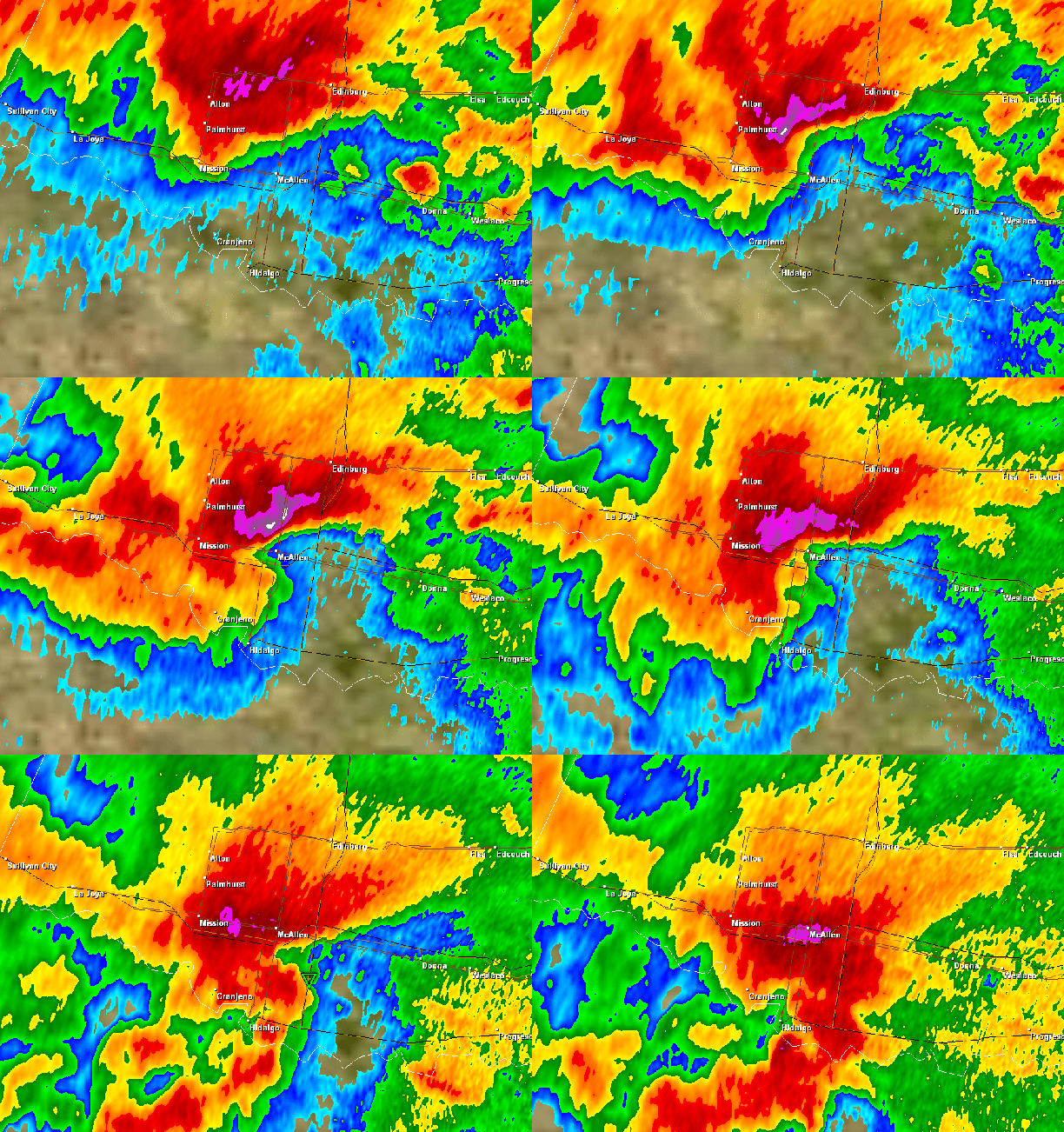
The March 29 storm hit just after the McAllen parakeets had gone to bed in the palms and live oaks along 10th street, huddled in their close-knit family groups beneath the perpetual twilight of the street lights. The devastation was instant, the storm’s fury unexpected. Between 848 and 941 pm, winds gusting up to seventy-four miles per hour drove quarter to baseball-sized hailstones at hurricane force along 10th Street, defoliating every tree within the impact zone, covering the ground with six inches of pelting ice, and accumulating hail drifts up to four feet high. Torrential rains accompanied the hail, creating ice-water rivers that choked city streets and submerged scores of vehicles in flood zones six feet deep. Lightning flashes electrified the highly-charged night sky from north to south, with strikes setting at least two apartment complexes on fire.

br_hail

As the storm passed and the hail began to melt, steam rose from the drifts of ice, creating a haze that soon reduced visibility across the city to zero. The storm had knocked out power to more than 25,000 Hidalgo County residents. Over 1,000 homes and businesses were impacted in McAllen. In all, the storm created as much as $300 million dollars in damage, making it one of the costliest to hit the state of Texas since 1950. Before the night was over, more than two hundred people required rescue from hail and wind damaged homes and from the rapidly rising flood waters. Fortunately, few injuries and no fatalities were reported—at least among the city’s human residents.

The next day, I arrived to find my familiar study area along 10th Street reduced to a war zone. Restaurant and office park windows were shattered, a local car dealership totaled. Buildings everywhere looked as if they had been strafed by machine-gun fire. Every leaf on every tree had been plucked, every palm frond shredded, creating a winter-bare landscape in a South Texas spring.

I feared the worst as I walked from 6th Street down to 10th and Violet. Mounds of hail were still melting everywhere I looked, up and down the street. Soon I began to see them: parakeets half-buried in debris, scattered across parking lots and sidewalks, tossed and broken by the storm. Many of the birds had no feathers on one side of their bodies—the hail had plucked them as neatly as it had stripped the leaves from the trees. The smell of death pervaded 10th Street as I searched the neighborhood, picking up parakeets one by one, until I had a garbage-bag full. Each bird looked as if it had been smashed by a hammer. Darkness fell before I could get them all.  Driving home exhausted that night, I was reminded of the Robert Frost poem:

Some say the world will end in fire,

Some say in ice.

From what I’ve tasted of desire

I hold with those who favor fire.

But if it had to perish twice,

I think I know enough of hate

To say that for destruction ice

Is also great

And would suffice.

fire and ice

The horror of the McAllen storm became a fresh wound in my memory as Harvey approached the Rio Grande Valley on 8/24/17, five and a half years after impact. If hail could take out so many of the birds that I loved, what would a Cat 3 hurricane do to them, to the many other species of wildlife that call South Texas home?

IMG_0063
Aurora, a newly-discovered color morph, photographed in McAllen, 9/10/2017

I had spent years following parakeets by the time Harvey came to call, had come to know individual family groups, had named any oddly marked birds that I was able to identify at a glance. Though many had died, a surprising number of the Valley parakeets had survived the hail in 2012. Could they survive Harvey?

harvey eye

That sleepless night, the great spiraling arms of the hurricane skirted South Padre Island close to home, as Harvey’s eye passed near the Rio Grande Valley, though remaining offshore. I waited for the power to go, braced myself for impact. Neither came, though satellite and wifi were temporarily offline, preventing me from accessing breaking news. I stepped outside to see what was happening, sheltered beneath one of the adobe house’s arched loggias.  The atmosphere was sultry, thick with heat and humidity, the night air hard to breathe. At 3am, a strong gust picked up. A squall of near-horizontal rain began, seeming to confirm my worst fears, but the wind almost immediately died away. Near dawn, I drifted off to sleep, waking up suddenly at mid-morning as if expecting the roof to be gone.

Opening my shuttered studio door, I stepped tentatively onto the front gallery, emerging from the house in the still-overcast light of a new day to discover that everything was as it had been before the storm. Nothing had been touched. The huge old ebony trees that shaded the walkway to the road were undamaged, their heavy seed pods still clinging to every bough. Chachalacas were braying from the private wildlife refuge behind our property. Cormorants, egrets, wood storks, and anhingas were perched and preening as usual across our tree-lined road, where a federal refuge protected a wetland fringed with South Texas bushland, a habitat teeming with life and sound. I stood in the middle of the road, marveling that not a single branch was down anywhere, that our Valley world had escaped unscathed. Returning to the house, I paused to watch a column of ants filing across our walkway, putting their world in order. Our mockingbird was singing in an ebony above. Sunlight filtered through the filigreed branches as the clouds began to break.

Our small corner of paradise had been spared. I could continue painting. The parrots would survive, at least for now. In that moment of pure elation, I could never have imagined how many other wondrous wild Edens were about change forever.

To Be Continued…

Part II: Crucible of Storms

Part III: Why Does The Sisserou Matter?