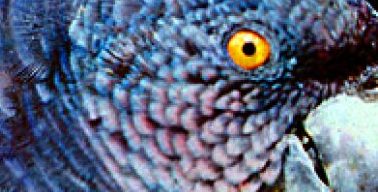
Listen to the Sisserou!

I’ve mentioned the Sisserou on nearly every post since creating this website, but have yet to introduce you to the living bird. Today’s post aims to remedy that omission. So please stop and take a moment to meet the resplendent Imperial amazon, Dominica’s national bird, up close and personal!

Shot in 2013 by David Monroger, today’s featured video offers a rare, intimate look at the critically-endangered Amazona imperialis. The clip also captures clear examples of the bird’s distinctive call note and voice. Once you’ve heard it, I think you’ll agree that the regal Sisserou sounds like no other parrot.

This particular bird is housed at the Dominica Parrot Conservation and Research Center at the Botanical Gardens at Roseau, Dominica’s capital city. She is one of only two Imperials currently in captivity, the sole captive female, and the only Sisserou held on Dominica. Along with a number of Red-necked amazons sheltered indoors during the storm, Dominica’s lone captive Sisserou survived Maria’s wrath. I will share more about her history in a later post.

So listen to the Sisserou, as we revel in the knowledge that Amazona imperialis, Dominica’s National Bird, survives in the wild today.

Listen to the Sisserou– and consider that wise old island parrots are wily and adapted to survive, sending us the clear and present message that even broken Edens can heal.
Trafalgar Falls

Thanks to David Monroger for permission to share the video here. An aviculturist, photographer, and writer based in France, David raises awareness about endangered parrots via his lectures, websites, and articles, work sourced on his global travels with fellow enthusiast Francois Deneaux. To learn more, please visit his Facebook page at https://www.facebook.com/pyaf.net/?fref=ts

The Sisserou LIVES!!

Breaking news today via the Birds Caribbean Facebook page:

“First confirmed sighting of the #Sisserou on #Dominica!!!! Spotted at Morne Saint Mary south of Roseau, thanks to Stephen Durand for sharing! The Imperial Parrot (endangered national bird) had not been seen since #HurricaneMaria decimated the island on 19 September-this is hopeful!!!! The parrot was spotted and photographed/filmed by Jerry Brisbane at his residence at Morne Saint Mary south of Roseau. I like how at second 8 he whispers to the parrot, “c’mon, make a call,” and it does so right on cue!!!


Sisserou and Jackot Update: A Word from Karl Watson

s-l1600

As we await confirmation of the Sisserou’s survival or extinction in the wild, I’d like to share the following 11/6 update from Karl Watson, first posted on the Wild Caribbean Facebook page. Karl is a resident of Bridgetown, Barbados– and has been providing regular updates as he receives them from his contacts on Dominica. Thank you, Karl, for allowing me permission to repost your news here, as follows:

“After being in the USA for a week, I checked with my friend Dr. Lennox Honychurch on my return to Barbados today. Here is the updated status on Dominica’s parrots which he reported to me…

Regarding the Imperial or Sisserou, there is as yet no word on their status following the passage of Maria. Apparently, none have been seen or heard.

The situation of the Red-necked parrots or Jackot is more promising. Lennox tells me that a flock of ten plus Red-necked parrots have taken up residence in a tree on his property which is adjacent to a cliff looking out towards Marie Galante, with many others flying around. They are feeding on the white cedar pods which have appeared on the many cedar trees by the sea cliffs as they regain their foliage following Maria. The parrots seem to have adapted their feeding patterns in order to survive, as this is the first time after many years residence in Woodford Hill that he has seen so many parrots close to the sea coast and actually roosting there. Their numbers are growing as stragglers find this flock and join it.

There are other areas where the Red-necked parrots are also concentrating e.g. at Governor, so the survival of this species seems assured. He received some bags of parrot food and other bird seeds which we sent down from Barbados. Apparently, the parrots prefer the seeds of the white cedar pods but other birds–doves etc.– have been feeding on the other seeds which he put out. I managed to buy some hummingbird feeders at a Walmart in Miami so I will send these down to him.

We should not yet give up hope for the survival of the Sisserou in the wild. It is possible that in other areas of the interior of Dominica not yet reached by officers of the Forestry Department that a few birds may have survived, though Lennox tells me that the recovery of the rain forest in the mountainous interior of Dominica is going very slowly. As he surveys the mountains through field glasses, most of the forest is still nothing but bare limbs and trunks.

We should remember our unfortunate sister islands after the horrific impact of Irma and Maria. Most of us will react with great sympathy in the immediate aftermath of such horrific destruction but our attention and sympathy tends to lag as the media shifts their attention very quickly to other areas of the world as other tragedies and crises unfold.

Like everyone else, I join in the hopes and prayers that this magnificent species has somehow survived the 200 mph+ winds that blew ferociously up the mountains…as well as the two other species of the upper areas: the Rufous-throated solitaire and the Blue-headed hummingbird.”